 FrontWars.io is an online multiplayer strategy game where you build and expand your territory while competing against other players on the same map. You begin with your own starting area and gradually try to become stronger by claiming territory, managing your resources, attacking rivals, and defending the borders you’ve already created. The basic idea is simple enough that you can understand what you’re supposed to do almost immediately, but the decisions become much more interesting once several players start competing for the same space.
I’ve always had a soft spot for browser strategy games.
Maybe it’s because they don’t make you commit to some enormous installation or spend an hour learning complicated systems before you can actually play. You open the game, figure out the basics, and you’re already making decisions.
FrontWars.io fits that style nicely.
At first, I thought it was going to be one of those games where you simply expand as quickly as possible and whoever owns the most territory eventually wins. After a few matches, I realized there was quite a bit more to it.
The map matters.
Your neighbors matter.
Your timing matters.
And, perhaps most importantly, your ability to avoid making a terrible decision when you’re feeling confident matters.
I’ve definitely had matches where everything seemed to be going perfectly. I was expanding quickly, my territory looked impressive, and I thought I had a comfortable advantage.
Then I attacked the wrong player.
Suddenly, I had a new enemy, a weaker position, and far too much territory to protect.
It was a useful reminder that success in FrontWars.io isn’t just about getting bigger.
You need to get stronger without becoming unnecessarily vulnerable.
That’s probably the first thing I’d explain to someone who has never played. Don’t worry about conquering the entire map immediately. Your first few games should be about understanding how expansion works and how much territory you can realistically manage.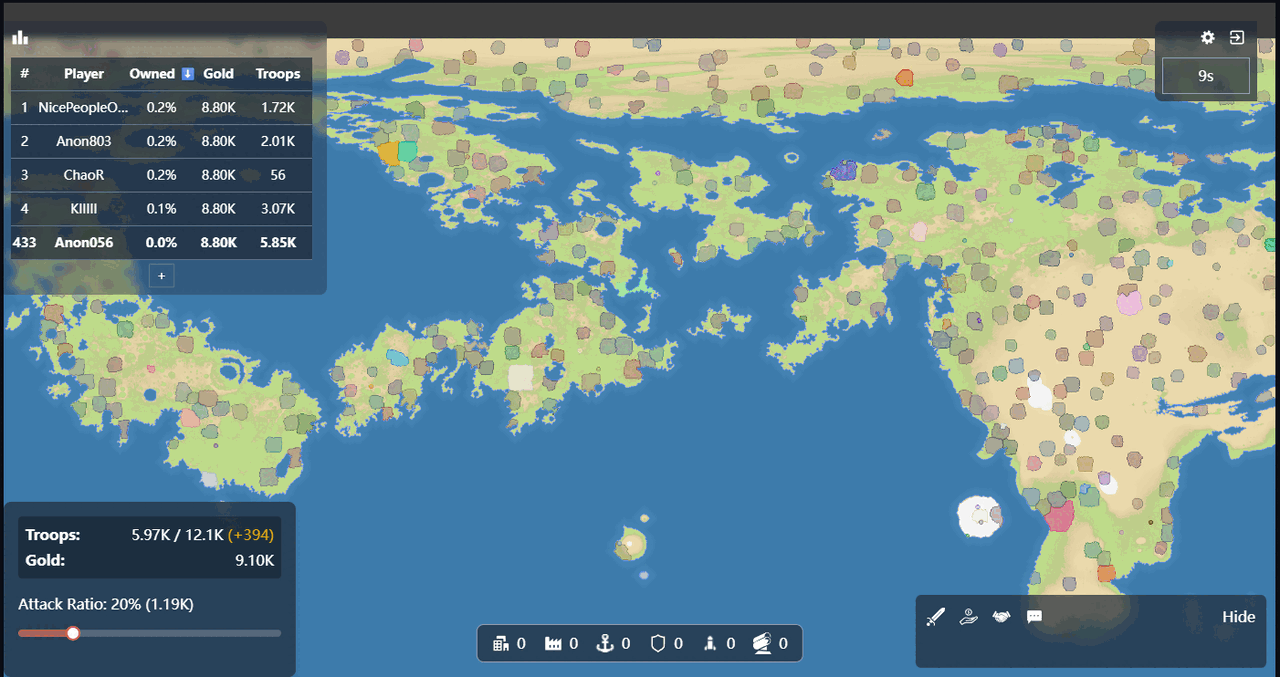
If you see an empty area next to your starting position, you can usually take advantage of it, but ask yourself what happens afterward. Will that new territory leave you exposed? Are you creating a border with another player? Is the area actually useful, or are you just taking it because it’s there?
New players often don’t think about the second question.
They see an opportunity.
Experienced players see the consequences.
That difference develops naturally as you play more.
I also recommend paying attention to what other players are doing instead of staring only at your own territory. It is very easy to get caught up in your own expansion and forget that everyone else has their own plans.
Meanwhile, someone else might be growing rapidly right next to you.
By the time you notice, they might already be strong enough to cause serious problems.
I’ve learned to check the map regularly, even when nothing seems to be happening. A quiet match can change very quickly. Two players might start fighting, one of them might suddenly lose a lot of strength, and an opportunity can appear where there wasn’t one a minute earlier.
That unpredictability is a big part of the fun.
FrontWars.io isn’t a fixed puzzle.
You can’t simply memorize one perfect strategy and expect it to work every time.
The players change.
The situation changes.
Your position changes.
You have to react.
For me, that makes the game much more replayable than it might appear at first.
I can play one match aggressively and try to expand quickly. In another, I might take a more defensive approach and focus on building a strong position. Sometimes I’ll avoid major conflicts entirely until I see a good opportunity.
That freedom is useful because not every player enjoys strategy games in the same way.
Some people love attacking.
Some people prefer careful planning.
Some people just want to see how large they can make their territory.
FrontWars.io gives you room to experiment with all of those approaches.
I think beginners should start with a relatively cautious strategy. Don’t try to fight everyone around you. Pick your battles carefully and learn how the map responds to your decisions. You don’t have to win your first match to have a successful first experience.
Actually, losing can be more educational.
I remember one match where I kept expanding because I thought I was doing well. I wasn’t watching my borders closely enough, and eventually another player attacked when my position was weakest.
Looking back, the warning signs were obvious.
At the time, I simply didn’t recognize them.
That’s normal.
The more you play, the more these situations become familiar. You start recognizing when someone is overextending. You notice when a player is becoming too powerful. You learn to distinguish between an attractive opportunity and an obvious trap.
For experienced players, that’s where the game starts becoming much more strategic.
You’re not just reacting to what is happening.
You’re trying to anticipate what might happen next.
You might notice that one player has created a vulnerable border and start preparing for the possibility of an attack. You might decide to leave another player alone because they are currently useful as a buffer between you and a stronger opponent.
These little decisions can have surprisingly large effects.
And that’s what I enjoy most.
FrontWars.io doesn’t always reward the player who looks the strongest right now. Sometimes the player who looks quiet and unimportant is actually building the strongest position.
That can make matches difficult to predict.
The presentation is also well suited to this kind of gameplay. The battlefield needs to be readable, especially when several players are expanding and fighting at the same time. I don’t want a strategy game to bury important information beneath flashy effects.
I want to look at the map and immediately understand what I’m seeing.
FrontWars.io keeps things relatively focused, which works in its favor.
There is also something satisfying about how quickly you can get into a match. You don’t need a huge amount of preparation. If you have a few minutes, you can play. If you want a longer session, you can keep going and experiment with different strategies.
That flexibility is one of the reasons browser strategy games remain appealing.
Of course, I think FrontWars.io could benefit from additional variety as it continues to develop. More maps, different scenarios, new mechanics, or alternative objectives could give longtime players more ways to enjoy the game. Once you understand the basic strategy, having new situations to deal with becomes increasingly important.
But the core gameplay doesn’t need much explanation.
You expand.
You defend.
You watch.
You make decisions.
Then you find out whether those decisions were smart.
That’s the fun part.
If you’re new to FrontWars.io, don’t worry about trying to become a master immediately. Learn the basics first. Understand your resources, watch the map, and think about what each expansion does to your overall position. Most importantly, don’t be afraid to lose.
You’ll learn more from a bad match than you think.
If you’ve already played for a while, start challenging yourself in different ways. Try a more aggressive strategy one game and a defensive strategy the next. See whether you can recognize dangerous situations earlier. Pay attention to how your opponents behave and try to predict their next move.
The game becomes much more interesting when you stop thinking only about your own territory.
Overall, I think FrontWars.io succeeds because it keeps the basic concept accessible without making the strategy completely shallow. You can understand the game quickly, but improving at it takes time.
That’s a good combination.
I don’t need every browser game to become a massive competitive experience with hundreds of mechanics. Sometimes I just want a map, a few rivals, and enough freedom to make my own decisions.
FrontWars.io gives me that.
And yes, I still make terrible decisions occasionally.
I still expand too far.
I still underestimate quiet players.
I still occasionally look at the map and think, “I’ve definitely got this,” immediately before everything goes wrong.
But that’s part of why I enjoy coming back.
You learn.
You adapt.
Then you start another match and try not to make the exact same mistake.
Usually, anyway.